

Licensed attorney since 2007. Licensed to practice law in Alabama, Mississippi, Georgia, and Washington D.C.
Multiple Vehicle Pile Up Crashes
Who is at fault in a chain-reaction crash? Why the order of impacts matters
A vehicle’s final position does not show who caused each impact in a chain-reaction crash. A middle vehicle may hit the car ahead before being struck from behind, or it may be pushed forward by a later collision. Both sequences can leave front and rear damage.
The order matters because it changes which act may have caused each contact. It still does not assign fault automatically. The evidence must connect each driver’s conduct to the impact and harm at issue.
Separate each contact
Same line of cars. Different impact order.
Hypothetical · not to scale · vehicles face right →. A is in front, B in the middle, C behind.
Timeline 1B is stopped, then pushed
A and B stop without contact.
First impact: C → B
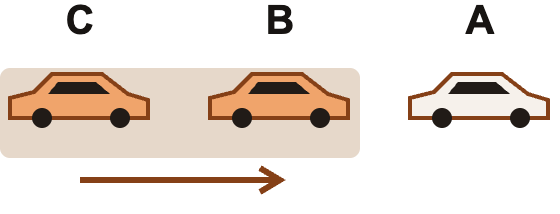
Then B is pushed into A
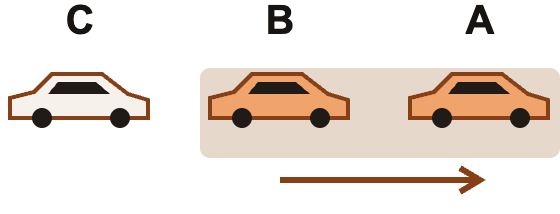
Timeline 2B hits A before C arrives
A stops; B cannot stop in time.
First impact: B → A
Later: C → B; B may hit A again
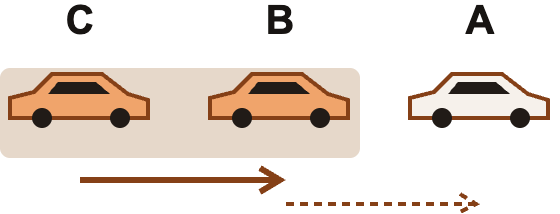
Damage alone does not establish impact order. Evidence must connect each driver’s conduct to the contact and harm; these examples do not assign fault.
Solid arrows: described contacts. Dashed arrow: possible repeat contact, not established. No measured speed, spacing or force is shown.
Evidence context: NHTSA’s EDR guidance and Georgia DPS crash-investigation policy. Neither source supplies these hypothetical events or a fault verdict.
Build the contact timeline first
Start with a contact-by-contact account:
- Before contact: What caused traffic to slow, stop, merge or change lanes? Where was each vehicle?
- First contact: Which surfaces touched first? Was the middle vehicle moving or stopped?
- Between contacts: Did anyone hear or feel a pause? Did a vehicle move, brake or regain control?
- Later contact: Was a vehicle pushed forward, turned or redirected?
- Final positions: Where did the vehicles, debris and damaged parts come to rest?
- Symptoms: When did each occupant first notice symptoms, and what movement or contact do they remember?
A police narrative or diagram may answer some questions, preserve conflicting accounts or leave the order unresolved. Compare it with the physical evidence, original files, witness accounts and medical chronology.
What the two timelines change
In the first example, B’s front contact follows C’s rear impact. In the second, B has already contacted A before C arrives. The investigation must distinguish those contacts and the harm associated with each.
Which evidence may clarify impact order?
Swipe or scroll to see all columns →
| Evidence | What it may show | What it cannot establish alone |
|---|---|---|
| Damage location and material transfer | Contact surfaces and possible vehicle orientation | Exact timing, force sequence or legal responsibility |
| Debris, marks and final rest positions | Movement through the scene and possible contact areas | A complete sequence after traffic, debris or vehicles move |
| Occupant and witness accounts | Sounds, pauses, movement and number of impacts | A perfect timeline from every vantage point |
| Dash-camera or nearby video | Visible positions and time between contacts | Events outside the frame or before recording began |
| Event data recorder information | Limited pre-crash or crash data when recorded | Minutes of travel, visual perception, every contact or fault |
| Phone, navigation or commercial records | Timing, route or activity relevant to a specific issue | Negligence without the surrounding facts |
| Medical chronology | When symptoms were reported and how they developed | Which impact caused an injury without medical and factual analysis |
NHTSA defines an event data recorder as a device that may capture technical vehicle and occupant information for seconds around a crash. NHTSA also says EDR data has significant limitations and should be used with other sources. Installation, recorded fields, triggering and retrieval vary; do not assume every involved vehicle contains useful data. Read NHTSA’s EDR guidance.
Georgia DPS’s published Traffic Crash Investigations policy, revised May 15, 2019, calls for photographs of marks, debris, final vehicle positions, damage relationships, view obstructions and road defects, along with a labeled sketch and prompt witness statements. The policy applies to those GSP investigations, but its checklist illustrates why a pileup should be documented as a scene and sequence rather than reduced to one damage photograph. Review the Georgia DPS crash-investigation policy.
Does a rear-end citation settle the sequence?
No. A citation records an enforcement decision. It may be relevant, but it does not by itself establish the order of every impact, resolve conflicting accounts or decide a civil claim.
Following distance, speed, distraction, lane changes and sudden stops may all matter. The useful question is how the evidence connects a particular act to a particular contact.
Symptoms and injury causation are different questions
A multi-impact crash can move an occupant more than once. Record the number and order of impacts as remembered, when symptoms first appeared, how they changed and what was reported to medical providers.
That chronology helps preserve the account. It is not a diagnosis, and it does not prove which impact caused an injury. Medical assessment and the collision evidence must be considered together. Vehicle damage alone cannot answer the medical-causation question.
What should each driver or passenger preserve?
- The report number, responding agency, exact location, direction of travel and lane
- Original photographs and videos of every vehicle and the overall scene
- Close photographs of front, rear and side damage before repair
- Names and contact information for occupants and independent witnesses
- The number, order and timing of impacts as remembered
- Dash-camera files, trip records, messages and navigation history already available
- Towing, storage and repair information for each involved vehicle
- Medical records and a timeline of symptoms and treatment
Put safety and medical care first. Do not step into traffic to gather evidence. Keep original files and ask an attorney whether an inspection is needed before a vehicle is repaired, destroyed or subjected to destructive testing.
Bring the disputed sequence into focus
Bodewell investigates early and builds the factual record carefully. You do not need a complete reconstruction before contacting the firm. Describe each contact you remember, identify what is disputed and bring the records already available.
For a multi-vehicle crash in Birmingham, Columbus or elsewhere in Alabama or Georgia, the impact sequence and governing state law should be evaluated together. See Bodewell’s guide to Alabama and Georgia fault rules or contact Bodewell Law for a review of the specific crash.
Sources and further reading
General information only: This page is not legal advice and does not create an attorney-client relationship. Deadlines, damages, defendants, and state-law rules depend on the facts. Read our full disclaimer before sending information.
No representation is made that the quality of legal services to be performed is greater than the quality of legal services performed by other lawyers.