

Licensed attorney since 2007. Licensed to practice law in Alabama, Mississippi, Georgia, and Washington D.C.
Motorcycle Accident Lawyers Fighting for Injured Riders in AL & GA
Motorcyclists have little protection in a collision. If you were injured in Birmingham or elsewhere in Alabama or Georgia, Bodewell can review the circumstances and explain your legal options. When a driver says they never saw you, the investigation should test visibility, timing and the available evidence.
The driver says they never saw your motorcycle. What evidence can show what happened?
“I never saw the motorcycle” is a starting point, not a reconstruction. The statement does not show where the driver looked, when a motorcycle became visible, what blocked the view or how the vehicles moved before impact.
A useful investigation separates three questions: what was visible, when the driver needed to look and which evidence can test the competing accounts.
The view changes before the impact.
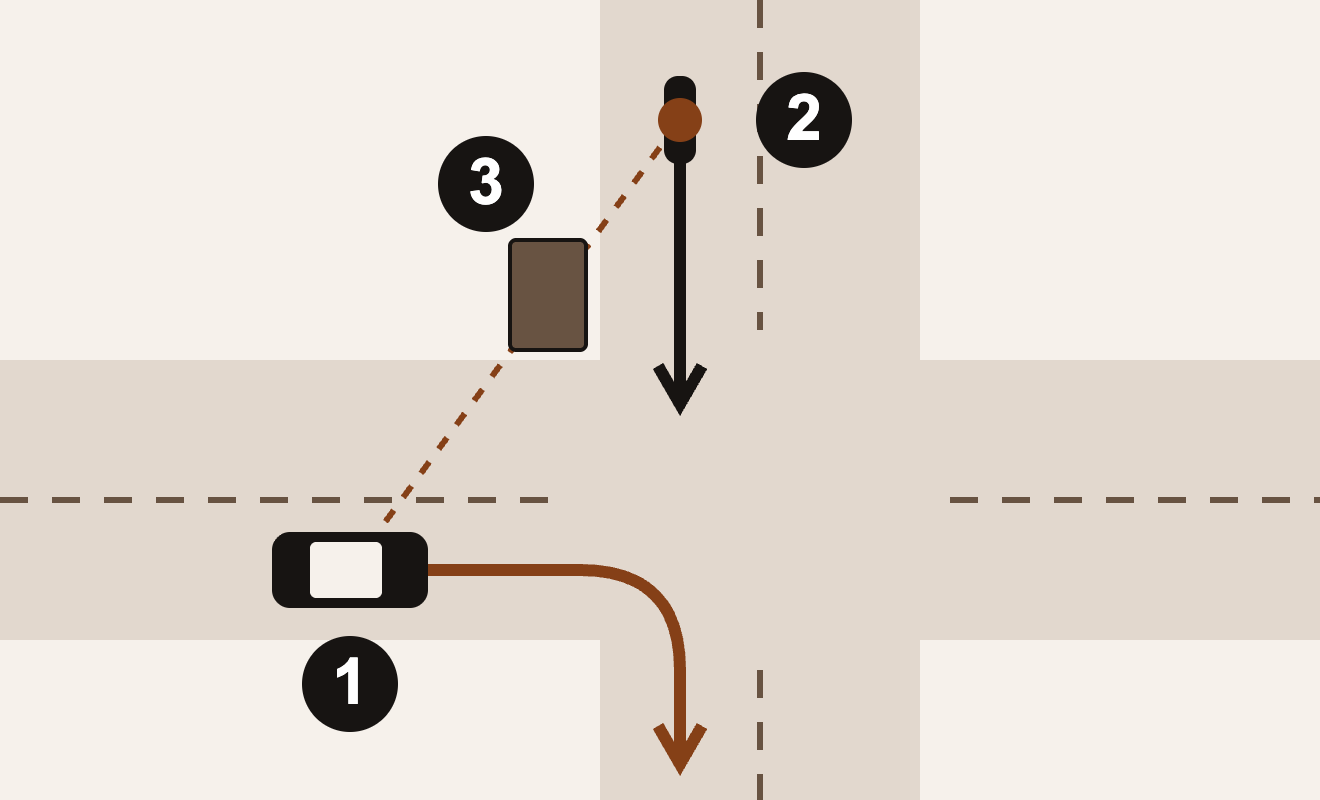
- Driver’s positionEastbound, turning right. Where and when did the driver look?
- Rider’s approachSouthbound. Where was the rider at that moment?
- Possible obstructionDid an object actually block the view?
Solid arrows: travel paths. Dashed line: sightline to test.
What was visible?
Start with the approach to the collision, not only the point of impact:
- Where was each road user in the seconds before the crash?
- Was a vehicle turning, merging, changing lanes or entering from a driveway?
- Could a windshield pillar, parked vehicle, traffic queue, sign, vegetation or construction have blocked the view?
- Did darkness, glare, rain, reflections or uneven lighting affect visibility?
- What do photographs or records show about the motorcycle’s lights?
- Did either road user brake, accelerate or change position before contact?
NHTSA’s motorcycle-crash pilot-study methodology documented roadway features, traffic controls, environmental conditions, sight distance, possible visual obstructions, vehicle contact points and damage. It is a useful model for the questions an investigation may ask, although it does not prescribe what must be done in a private Birmingham claim. Review the NHTSA pilot study.
When did the driver need to look?
Timing gives the visibility question meaning. A left-turn crash may require attention to the driver’s view before starting the turn. A lane-change crash may call for a different look at mirrors, blind areas and the vehicles’ relative positions. A crash at a driveway may turn on when each vehicle entered the other’s path.
Consider a hypothetical Birmingham intersection crash. A rider says the signal was green. A left-turning driver says the motorcycle was never seen. Scene photographs may help test sight lines. Vehicle damage may help show orientation at contact. A witness or nearby camera may help with movement or timing, if a useful recording exists. Signal records may matter only if the correct agency has responsive information about the disputed time or condition.
Each source can narrow the timeline. None automatically decides fault.
Which evidence can test the accounts?
Swipe or scroll to see all columns →
| Evidence | What it may help clarify | Important limit |
|---|---|---|
| Scene photographs and measurements | Approach paths, sight lines and possible obstructions | Later conditions may differ from the crash scene |
| Signals, signs and lane markings | How movements were controlled | The responsible agency and responsive record still must be identified |
| Motorcycle and vehicle damage | Contact areas and vehicle orientation | Damage does not supply the full sequence by itself |
| Lighting and weather information | Darkness, glare, rain or reflections | General weather data may not recreate the exact location |
| Driver, rider and witness accounts | Movements, lights, sounds and pauses | Memory, attention and vantage point differ |
| Video, photographs and electronic data | Visible movement or limited recorded variables | Existence, retention, field of view and recorded fields vary |
NHTSA’s Special Crash Investigations program combines scene and vehicle inspections, photographs, interviews, official records and event data when available. NHTSA also explains that an event data recorder may capture limited technical information for seconds around a qualifying event and should be assessed with other evidence. It does not record what a driver visually perceived. See NHTSA’s investigation method and EDR guidance.
Where can Birmingham record questions begin?
Identify the exact location and responding agency first. The Birmingham Police Department Records Division explains how eligible people can obtain accident reports held by BPD. ALEA provides a separate statewide crash-report route. A report is an important starting record, but it is not the final word on civil responsibility.
Road control may matter too. The Birmingham Department of Transportation lists city responsibilities involving traffic signals, street lighting, signs, markings and transportation infrastructure. That does not establish that BDOT controlled a particular location or possesses a useful record. Confirm the roadway owner and the specific condition before making a request.
Note nearby homes, businesses, buses and vehicles that may have cameras. Do not assume that a camera captured the crash or that a recording was retained.
Legal help for injured motorcycle riders
Our Birmingham motorcycle accident lawyers represent riders injured by negligent drivers, unsafe road conditions, defective motorcycle parts, and careless commercial operators. The investigation should connect the responsible party’s conduct to the crash and resulting harm.
Alabama riding requirements and state fault rules
Alabama riding requirements
- Motorcycle operators and passengers generally must wear approved protective headgear.
- A motorcycle operated or registered for public-road use generally must have the liability coverage required by Alabama law.
- Alabama generally prohibits riding a motorcycle between lanes of traffic or adjacent rows of vehicles.
How fault affects an Alabama claim
Alabama generally applies contributory negligence to ordinary negligence claims. If the defense proves that the injured person’s own negligence contributed to the injury, recovery on that claim can be barred. An allegation of fault does not establish the defense; the evidence and any applicable exceptions still matter.
How fault affects a Georgia claim
In a claim governed by Georgia’s comparative-fault rule, the injured person’s share of fault can reduce damages. A person who is 50 percent or more responsible cannot recover under that rule. Being below 50 percent does not, by itself, establish the other requirements of the claim.
Proving Negligence in Motorcycle Accident Cases
A negligence claim requires evidence of a legal duty, a breach of that duty, causation and damages. Other potential claims, including claims involving a defective product, require their own legal analysis.
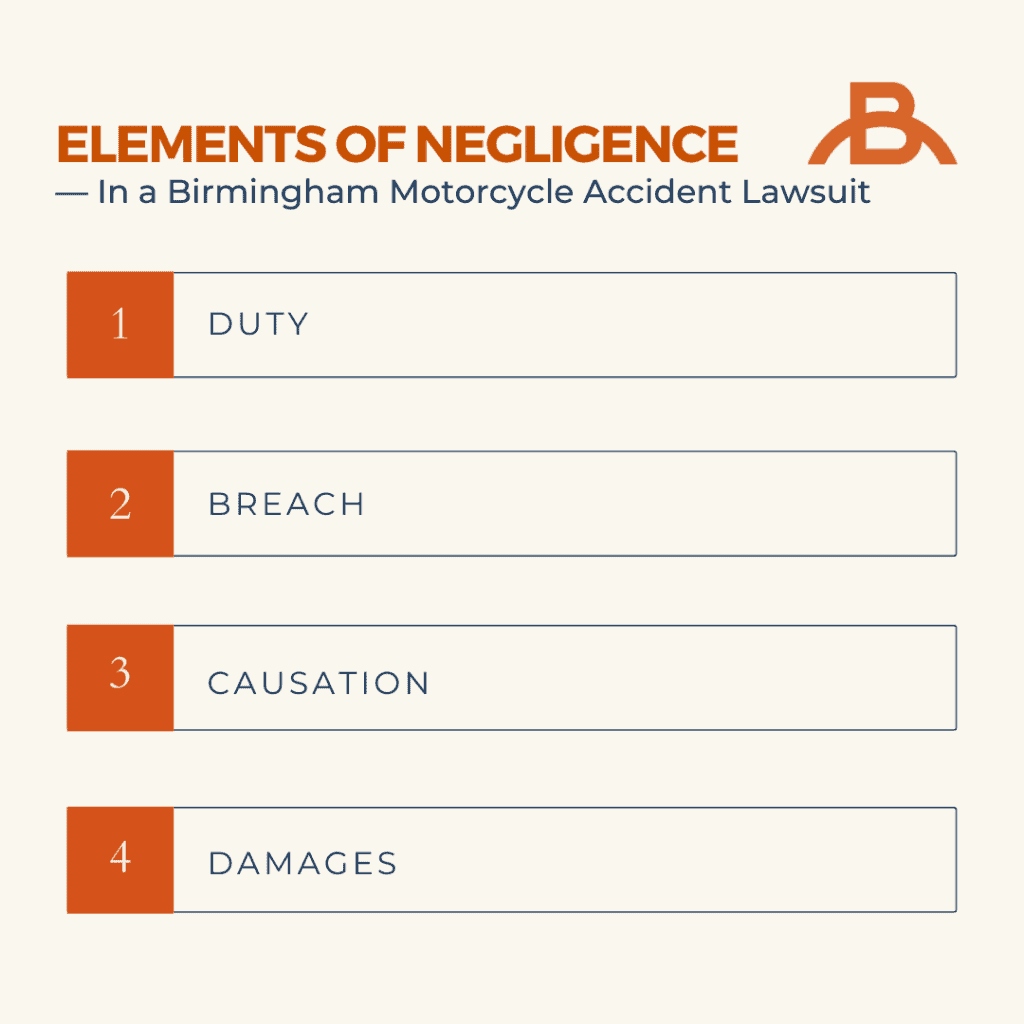
- Duty: Drivers must operate vehicles safely and follow traffic laws.
- Breach: Speeding, distraction, impairment, or illegal maneuvers.
- Causation: The breach caused the motorcycle crash.
- Damages: Medical bills, lost income, pain, and long-term harm.
Common Injuries From Motorcycle Accidents
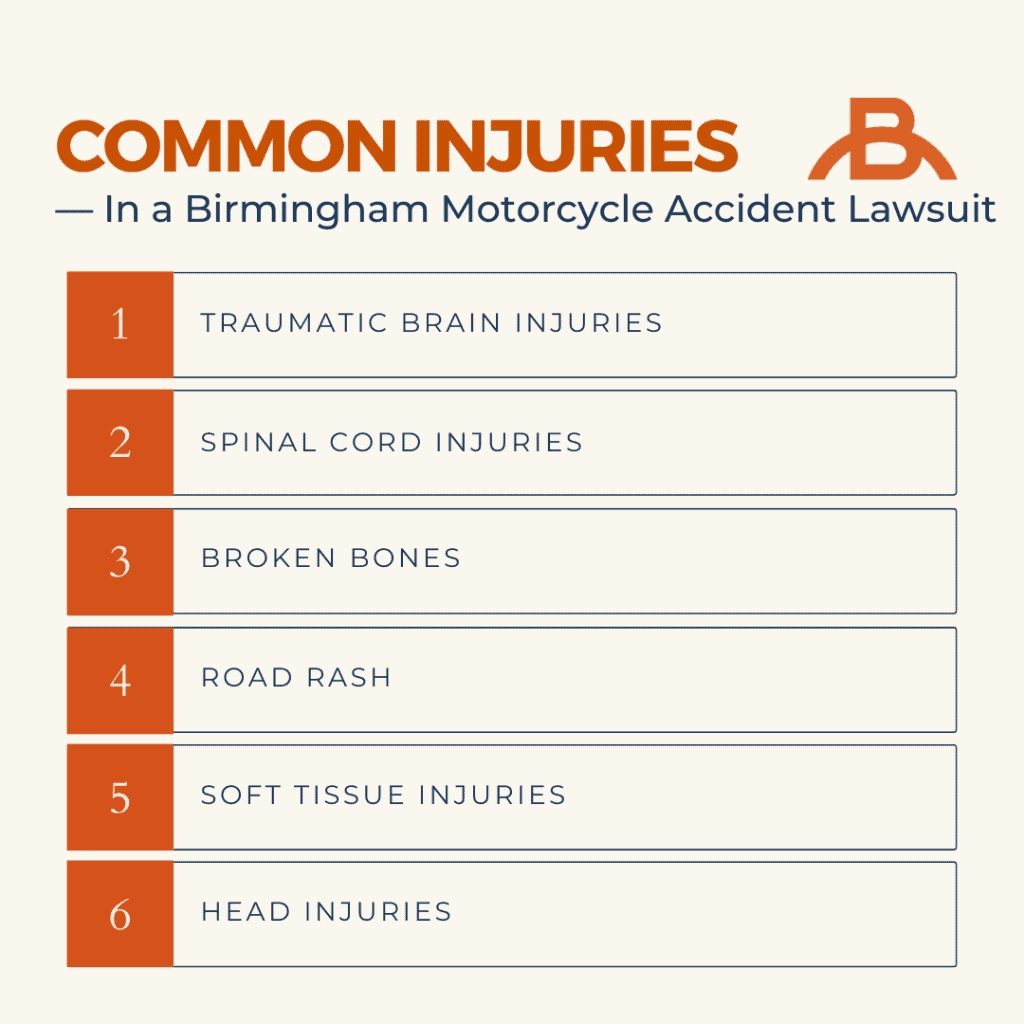
- Traumatic brain injuries (TBIs) and concussions
- Spinal cord injuries and paralysis
- Broken bones and complex fractures
- Road rash and severe skin injuries
- Soft tissue injuries and chronic pain
- Permanent disability or disfigurement
Compensation Available After a Motorcycle Crash
- Emergency medical care, surgery, and rehabilitation
- Future medical treatment and long-term care
- Lost wages and reduced earning capacity
- Pain, suffering, and emotional distress
- Property damage to your motorcycle and gear
If a rider dies, the person authorized to bring a claim and the available damages depend on the governing state law. A wrongful-death claim requires separate analysis from the injured rider’s personal-injury claim.
Deadlines Matter—Protect Your Rights
Many personal-injury claims in Alabama and Georgia have a two-year filing period. The claim, defendant, accrual date and any applicable exception can change the analysis. Some government claims also require notice before suit on a shorter timetable. Confirm the requirements promptly rather than treating two years as time to wait.
What To Do After a Motorcycle Accident
- Put medical care and personal safety first. Call law enforcement when needed and keep the report number and responding agency.
- If it is safe, photograph the overall scene, vehicle positions, damage and possible view obstructions. Do not enter traffic or handle dangerous debris.
- Save original photographs, videos and dash- or helmet-camera files. Keep witness contact information and note the exact location and travel directions.
- If practical, preserve the motorcycle, helmet and damaged riding gear in their post-crash condition. Keep towing, storage and repair records, and ask an attorney whether an inspection is needed before repair, disposal or destructive testing.
- Write down what you remember while it is fresh. Ask an attorney about your obligations and options before giving a recorded insurance statement, and do not ignore a reporting deadline.
Bring the disputed visibility question into focus
Bodewell’s approach starts with early investigation, securing evidence before it is lost and building the factual record carefully. You do not need every record before starting that conversation. Bring the exact location, travel direction, original files and the accounts that are in dispute.
Sources and further reading
General information only: This page is not legal advice and does not create an attorney-client relationship. Deadlines, damages, defendants, and state-law rules depend on the facts. Read our full disclaimer before sending information.
No representation is made that the quality of legal services to be performed is greater than the quality of legal services performed by other lawyers.
Past results do not guarantee future outcomes.
Frequently Asked Questions
Why Should I Hire a Birmingham Motorcycle Accident Lawyer?
There are a number reasons as to why you should hire a motorcycle accident lawyer.
If you’ve been injured in a bike crash, you need someone on your side who knows Alabama motorcycle law and is equipped to fight for you.
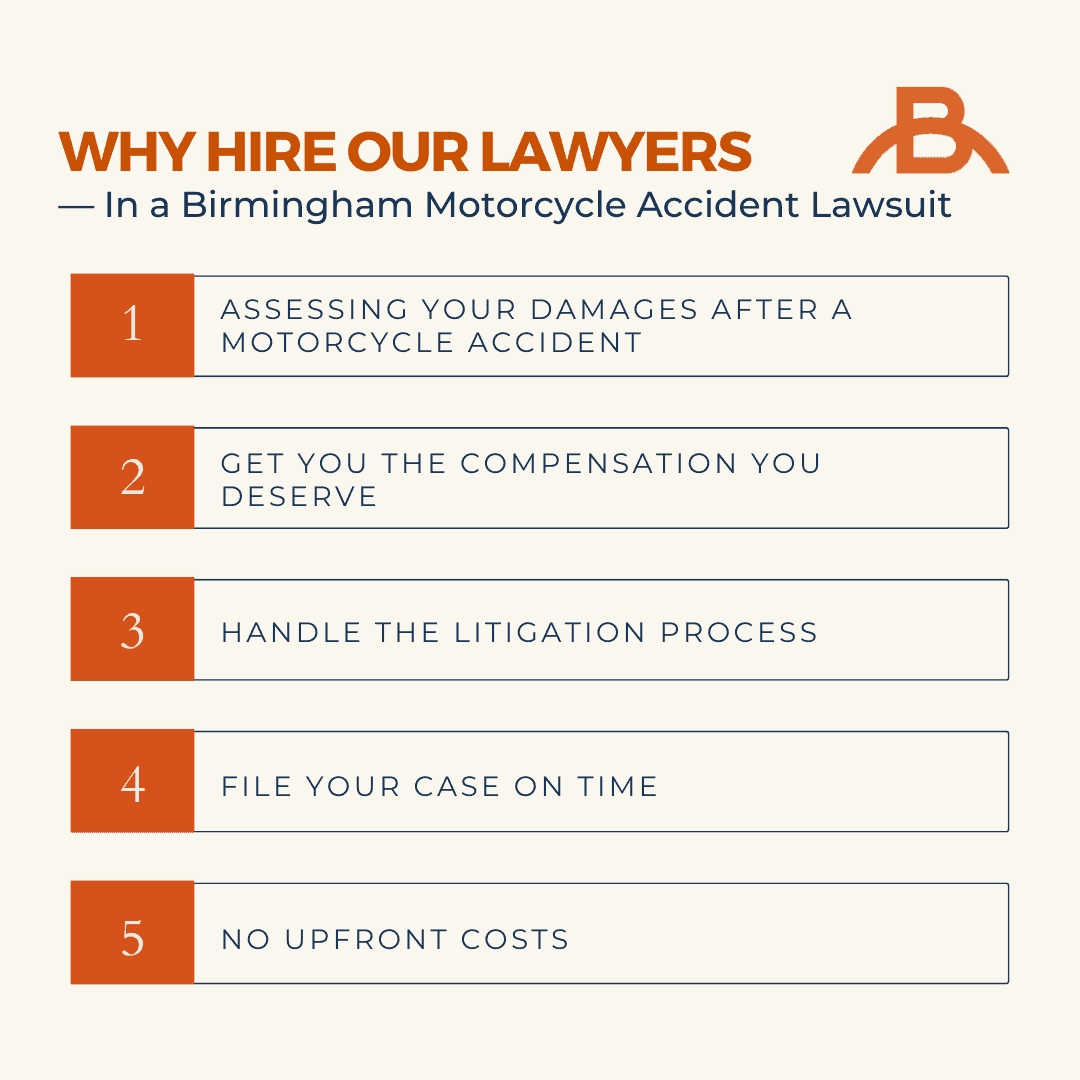
There are many advantages to hiring a lawyer, such as the following five (5) examples:
1. Assessing Your Damages After a Motorcycle Accident
One of the most important things a lawyer will do is help you assess your damages.
Damages are the total losses, economic and non-economic, that you incur as a result of an accident.
Damages in a motorcycle crash will not only your physical injuries, but also your property damage, lost wages, future medical expenses, pain and suffering, and other losses, tangible and non-tangible.
Properly assessing damages is important as it will affect the amount of compensation you may be entitled to.
2. Get You The Compensation You Deserve
Most car accident and motorcycle accident cases are settled through insurance company proceedings.
Insurance companies are often reluctant to pay out large settlements and will not cover the full scope of potential damages caused to the victim.
Experienced motorcycle accident lawyers will be able to determine the full scope of your damages and ensure that you are fully compensated for all potential expenses.
Your lawyer will negotiate with representatives of the at-fault party’s insurance company to reach an adequate settlement amount.
If they are unable to reach a settlement, your attorney can proceed with continued legal action and try your motorcycle accident case in front of the courts.
3. Handle The Litigation Process
When you’re dealing with a motorcycle accident, the last thing you want to worry about is the legal process.
A lawyer will handle all the legal details for you so you can focus on your recovery – this work includes:
- Filing paperwork
- Dealing with the insurance company
- Working through the civil litigation process
- Going to court if necessary
An experienced attorney will keep you in the loop and updated on the status of your case.
4. File Your Case On Time
If you’ve been injured in a motorcycle accident, you must file a claim within the statute of limitations.
An experienced motorcycle accident attorney will make sure your case is filed on time and correctly.
In Alabama, the statute of limitations is two (2) years from the date of the accident:
- The Alabama Statute of Limitations is this is the deadline for filing a personal injury lawsuit.
If you don’t file your case within this two years from the date of the accident, you may be barred from seeking compensation.
5. No Upfront Costs
When you hire a lawyer from Bodewell Law, you don’t have to worry about any upfront costs.
Our Birmingham Motorcycle Accident Attorneys work on a contingency basis, which means you only pay for legal representation if your case is won.
This means you can get the legal help you need without having to worry about how you’re going to pay for it.
Contact a Birmingham motorcycle accident lawyer today to get started on your case.
What Compensation Can I Recover After a Motorcycle Accident in Birmingham, Alabama?
The amount of compensation you can recover after a motorcycle accident depends on the severity of your injuries.
Generally, the more severe your injuries are, the higher your damages will be.
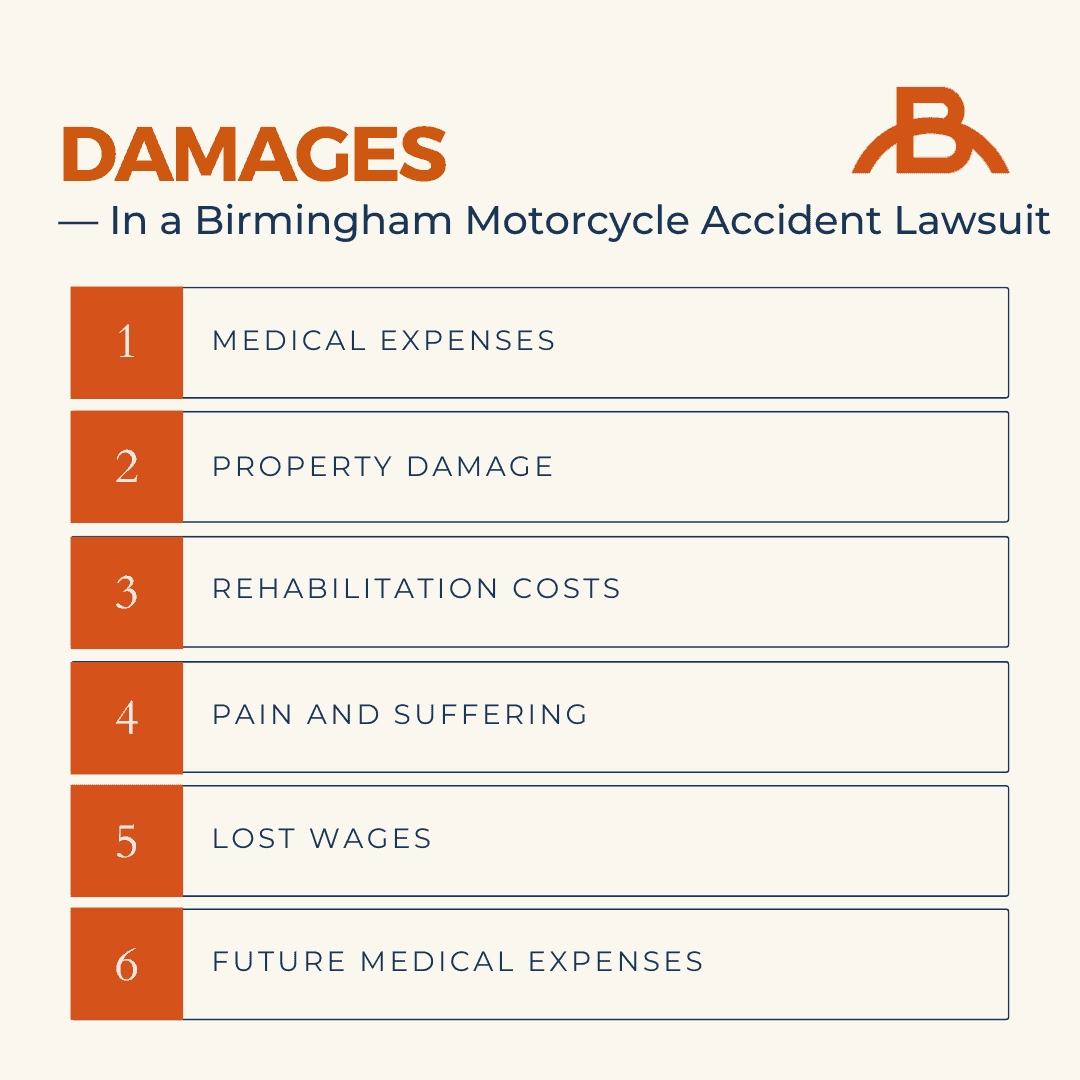
Compensation can cover things like medical bills, lost wages, and pain and suffering.
If you’ve been in a motorcycle accident, contact a Birmingham motorcycle accident lawyer today to get started on your case.
The first step is to schedule a free consultation with one of our experienced lawyers.
During this consultation, we will review your case and answer any questions you have.
We will also explain your legal options and help you decide if filing a lawsuit is the right choice for you.
If you decide to move forward with your case, we will work tirelessly to get you the compensation you deserve.
Contact us today to schedule your free consultation.