
Thinking About Filing an SF-95 for an FTCA Claim? Talk to a Lawyer First

If you were hurt by a federal employee, someone may have handed you a two-page government form called Standard Form 95, or SF-95. Maybe it was a postal worker, a VA hospital, or a military servicemember. Or maybe you found the form online after your accident or injury. It looks simple: a few boxes about what happened, a space for a dollar amount, and a signature line.
Many people fill it out, mail it in, and only then call a lawyer. By that point, some of the most important decisions in the case have already been made, and some of them can't be undone.
The best time to talk to a lawyer about a potential Federal Tort Claims Act (FTCA) claim is before you file the SF-95. And most people don't realize that a lawyer can prepare, sign, and file the SF-95 for you and handle the entire claim with the government from there.
The SF-95 Isn't Just a Form. It Is Your Claim.
With a typical car wreck, you can call the other driver's insurance company, report the accident, and sort out the details later. A claim against the federal government doesn't work that way.
Under the Federal Tort Claims Act (FTCA), you generally can't sue the United States until you first file a written claim with the federal agency involved and give it a chance to respond. That written claim, usually an SF-95, isn't just a heads-up that something happened. It's the official claim itself, and it sets the boundaries for everything that comes after.
What you put on that form can affect:
- How much money you can ever recover, even if your case later goes to court
- Whether your claim counts at all, or gets treated as if it was never filed
- Who is included in the claim, such as a spouse or the estate of a loved one
- What the government investigates and what you can argue later
That's why the SF-95 should be treated as the foundation of your case, not a formality.
Five Ways a Do-It-Yourself SF-95 Can Hurt Your Case
1. Asking for too little money
The SF-95 requires a "sum certain," a specific total dollar amount. "To be determined" or "whatever is fair" is not enough, and a claim without a specific number may not count.
Here's the trap: with very few exceptions, you can't later recover more than the amount you put on the form, even if a judge would otherwise award you more.
A lawyer looks at the whole picture before choosing a number. That includes your current medical bills, likely future treatment, lost pay, reduced ability to work, pain and suffering, and property damage. The goal is a number you can support with evidence, not a guess.
2. Sending it to the wrong place, or about the wrong person
An FTCA claim has to go to the federal agency whose employee caused your injury. That isn't always obvious. And not everyone who works at a federal building, VA hospital, or community clinic is a federal employee. Some are private contractors, and claims against contractors follow completely different rules and deadlines.
Sending your claim to the wrong agency, or filing a federal claim when the responsible person wasn't a federal employee, can cost you time you may not have.
3. Describing what happened too vaguely
The agency has to be able to investigate your claim based on what you wrote. If your description is too thin, or it leaves out an important part of what went wrong, you may have trouble raising that issue later. A lawyer makes sure the claim clearly describes the incident, the people involved, and the injuries and losses that resulted.
4. Leaving people out of the claim
Each person with their own losses may need their own claim. For example, a spouse whose life has changed because of your injuries may have a separate claim that has to be filed separately. If someone has died, only a person with legal authority, such as a properly appointed representative of the estate, may be able to sign. Getting this wrong can leave family members without a claim at all.
5. Getting the timing wrong
There are two timing problems, and they pull in opposite directions:
- Waiting too long. An FTCA claim generally must be received by the right agency within two years after the claim "accrues." That's often the date of injury, but not always, especially in medical cases. Dropping it in the mail isn't enough. If it arrives late or goes to the wrong office, the claim may be barred forever.
- Filing too early. Filing within days of an injury, before you know how serious it is, can lock in a dollar amount that's far too low.
A lawyer can help you balance those risks and choose the right time to file. They'll also keep proof of when the agency received it.
Yes, a Lawyer Can Prepare and File Your SF-95 for You
Many people who may have an FTCA claim assume they have to fill out the SF-95 themselves and that a lawyer only gets involved if there's a lawsuit. That isn't true. Federal rules allow a claim to be signed and submitted by a properly authorized legal representative, and the SF-95 itself has a place to identify your representative.
When Bodewell handles your FTCA claim from the start by filing the SF-95 for you, we can:
- Investigate what happened and confirm whether the person responsible was a federal employee acting within their job scope
- Identify the correct federal agency and confirm how it accepts claims
- Gather the evidence, including medical records and bills, wage information, photographs, reports, and witness information
- Calculate a supported sum certain that accounts for future losses, not just today's bills
- Prepare, sign, and file the SF-95 along with a detailed demand letter and supporting documents, and keep proof of delivery
- Make sure every person with a claim is included, with the right paperwork showing who has authority to sign
You still make the important decisions about your case. You just don't have to figure out the federal rules on your own.
The Administrative Claim Is Where Many Cases Are Won or Lost
For an FTCA claim, filing the SF-95 is the beginning, not the end. Once the agency receives your claim, it may:
- Ask for more medical records, bills, wage proof, or other documents
- Review records and talk to the people involved
- Get its own medical or expert opinions
- Make a settlement offer, deny the claim, or keep reviewing it past six months
Each of these steps matters. How you respond to a request for evidence can strengthen or weaken your claim. A settlement offer may look reasonable but leave out future medical care. And accepting an administrative settlement generally ends your claim for good. You can't come back later for more.
If the agency denies your claim in writing, a strict six-month deadline to file a lawsuit in federal court generally begins. If the agency hasn't decided after six months, you may have the option to go to court, but whether that's the right move is a strategic decision.
When a lawyer is handling your claim, the agency deals with your lawyer, not you. We respond to evidence requests, negotiate with the government, evaluate any offer against your full losses, and track every deadline.
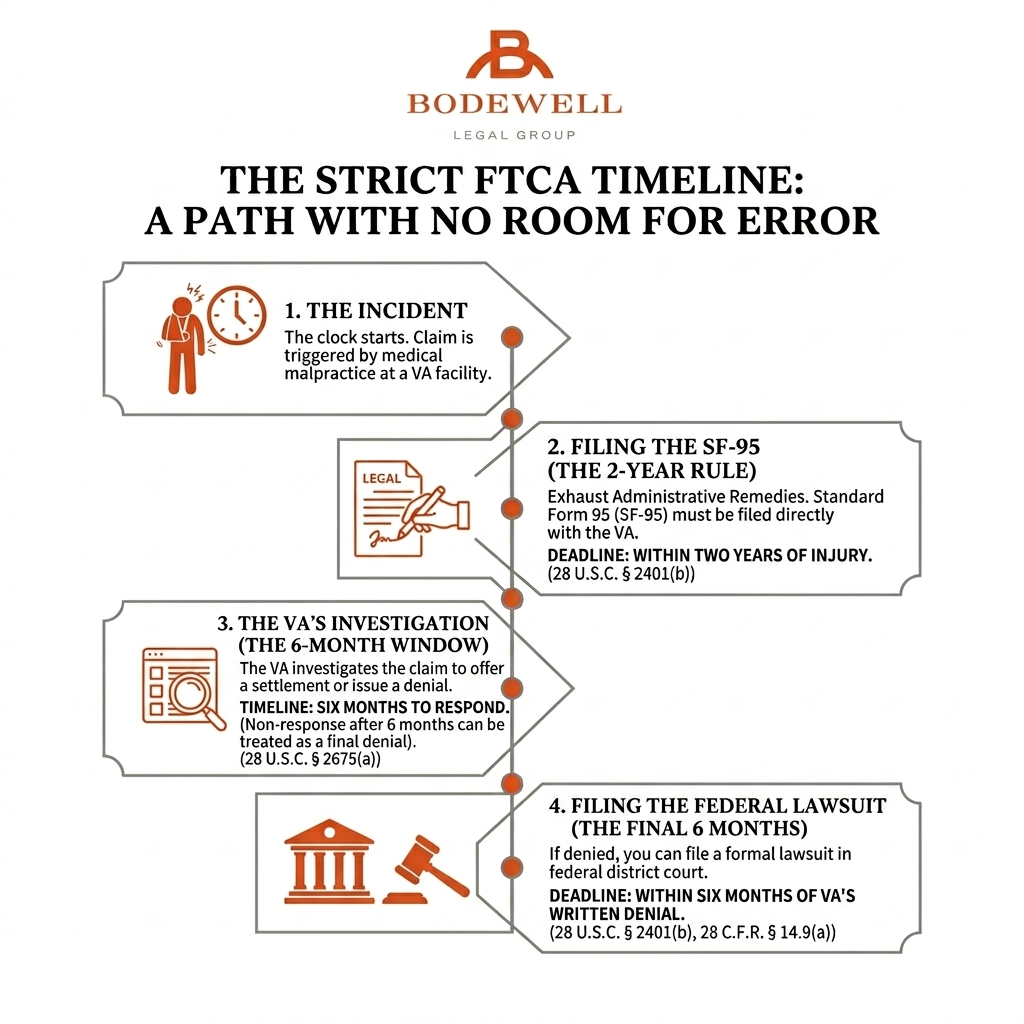
Read the infographic text
The strict FTCA timeline: a path with no room for error
1. The incident
The clock starts. Claim is triggered by medical malpractice at a VA facility.
2. Filing the SF-95 (the 2-year rule)
Exhaust Administrative Remedies. Standard Form 95 (SF-95) must be filed directly with the VA. DEADLINE: WITHIN TWO YEARS OF INJURY. (28 U.S.C. § 2401(b))
3. The VA’s investigation (the 6-month window)
The VA investigates the claim to offer a settlement or issue a denial. TIMELINE: SIX MONTHS TO RESPOND. (Non-response after 6 months can be treated as a final denial). (28 U.S.C. § 2675(a))
4. Filing the federal lawsuit (the final 6 months)
If denied, you can file a formal lawsuit in federal district court. DEADLINE: WITHIN SIX MONTHS OF VA’S WRITTEN DENIAL. (28 U.S.C. § 2401(b), 28 C.F.R. § 14.9(a))
What Does It Cost to Have a Lawyer Handle the Claim?
Many people worry that hiring a lawyer for the "paperwork stage" to file an SF-95 will be expensive. In FTCA cases, federal law limits what a lawyer can charge. Attorney fees are generally capped at 20% of an administrative settlement and 25% of a settlement or judgment after a lawsuit is filed.
Bodewell offers a free case review, and you don't pay attorney fees unless we recover compensation for you.
Your Free Case Review
A case review before you file an SF-95 is the chance for a lawyer to review your situation and help come up with a clear gameplan. But you don't need to have everything organized at the start. Just bring what you have, such as:
- Any letters, emails, or claim numbers from a federal agency
- Medical records, bills, and the names of the doctors or facilities who treated you
- Accident or incident reports, photos, and witness names
- Pay stubs or other proof of lost income
- A short timeline of what happened and when
Even if you don’t have any of these items yet, an experienced FTCA lawyer at Bodewell can help you figure out what you need and the best way to get it.
Frequently Asked Questions
Do I have to fill out the SF-95 myself?
No. An experienced lawyer can prepare, sign, and file your claim for you, with documentation showing they represent you.
Can't I just file the SF-95 now to "get it on record" and hire a lawyer later?
That's the most common mistake we see. The SF-95 isn't a placeholder. The dollar amount, the agency you send it to, the people included, and the description of what happened can all shape, and limit, your case from that point forward.
What if I'm close to the two-year deadline?
Call immediately. A lawyer can move quickly to file a valid claim and confirm the agency received it in time. Remember, the deadline is based on when the agency receives the claim, not when it's mailed.
Will hiring a lawyer slow things down?
Usually the opposite. A complete, well-supported claim gives the agency what it needs to evaluate your case, rather than a back-and-forth over missing information.
Does filing an SF-95 mean the government will pay?
No. Filing starts the process. You still have to show that a federal employee was at fault and that their conduct caused your injuries and losses.
I already filed and the agency made me an offer. Should I take it?
Talk to a lawyer before you sign anything. Accepting an administrative settlement generally releases your claim completely, including any future losses you didn't account for.
Hurt by a Federal Employee? Call Before You File.
Whether you were injured by a postal vehicle, harmed by care at a VA facility or a federally funded community health center, or hurt by another federal employee, Bodewell can handle your claim from the very first form. Learn more about your rights after an injury caused by a federal employee by giving us a call today.
Alabama: (205) 533-7878
Georgia: (706) 550-9000

About the Author
Roger Grantham is an attorney at Bodewell Injury Group in Columbus, Georgia. Roger has ample experience handling FTCA cases and SF-95s. Before joining Bodewell, he worked for the U.S. Attorney’s Office representing the federal government in FTCA cases. From that experience, Roger knows the ins and outs of the federal system and now uses that knowledge to help those injured by the federal government.
Official Sources and Further Reading
- Standard Form 95 — U.S. General Services Administration
- 28 C.F.R. § 14.2 — Presentment and amendments
- 28 C.F.R. § 14.9 — Final denial and reconsideration
- 28 U.S.C. § 2675 — Administrative claims and recovery limits
- 28 U.S.C. § 2401 — Filing deadlines
- 28 U.S.C. § 2678 — Attorney fees
- Health center FTCA coverage — HRSA frequently asked questions